
Local search has become one of the most important ways people discover businesses. Whether someone needs an insurance agency, a lawyer, dentist, or accountant, they often search for a service within a specific city or neighborhood.
Search engines analyze hundreds of signals to determine which businesses best match those local searches, making geographic relevance an essential part of modern SEO.
For businesses serving multiple locations, building local visibility presents a unique challenge. A single service page rarely provides enough context to demonstrate relevance across different cities or regions.
At the same time, creating dozens of similar pages without meaningful local information often produces disappointing results because search engines prioritize helpful, original content.
Strong local search performance depends on more than keywords and business listings. Content quality, website structure, user experience, technical SEO, and local relevance all work together to influence how location-based pages perform.
Understanding these factors helps businesses create pages that are useful for visitors while aligning with search engine expectations.
This guide explores the strategies, structure, and best practices behind effective local SEO landing pages and explains the elements that contribute to stronger local search visibility over time.
Create local SEO landing pages by targeting one location per page, matching local search intent, writing unique content, optimizing on-page SEO, adding local business details, and making each page genuinely useful for people searching in that specific area.
Every local landing page should focus on a single location and a single primary service. Instead of combining multiple cities into one page, dedicate each page to one geographic area. This makes it easier for search engines to understand relevance while helping you improve the experience for visitors.
The page should answer the questions someone in that location is likely to ask. Include local information, explain the services available there, and provide clear calls to action. A visitor should immediately know they have reached the right page without searching elsewhere on the website.
Building local landing pages also requires a solid technical foundation. Fast loading speeds, mobile-friendly layouts, secure hosting, and clean site architecture all contribute to better performance.
Before exploring how to build these pages, it is important to understand why they play such a significant role in local search visibility.
Local landing pages matter because they help search engines match your business with location-based searches, improve visibility in target service areas, and give visitors relevant information that supports stronger rankings and a better user experience.
Search engines look for pages that closely match both the service and the location being searched. Dedicated local landing pages provide that relevance.
Google explains that local search ranking depends on three primary factors:
A local landing page directly improves relevance because it clearly identifies the services available within a specific area.
Businesses with several service locations benefit even more. Rather than competing with themselves using one broad page, they allow each location page to rank independently for local searches.
These pages also create opportunities to answer location-specific questions, highlight local expertise, include community information, and provide visitors with content that feels tailored rather than generic.
Well-organized local pages improve navigation as well. Visitors can quickly select their city instead of scrolling through long lists of locations inside a single page.
Effective local landing pages are built on research that identifies the right audience, locations, and search opportunities.
Keyword research, location research, and search intent determine what each local landing page should target. Understanding these before writing helps create focused pages that match relevant local searches and user expectations.
Every local landing page should begin with research, not writing. Before creating content, identify the location you want to target, the service you want to promote, and the keywords people use when searching for that service.
Search intent explains what users expect to find after clicking a page. Understanding that intent helps you decide what information each landing page should include.
For example:
Each search requires content that matches the user’s intent.
The table below shows common examples of local search intent.
| Search Query | User Intent | Recommended Page |
| Dentist Chicago | Find a local provider | Service landing page |
| Roofing Company Tampa | Compare contractors | Location page |
| Mortgage Broker Denver | Find nearby services | Local landing page |
| Car Accident Lawyer Miami | Hire legal help | Practice area page |
| Emergency Electrician Boston | Immediate assistance | Service page with contact CTA |
The U.S. Small Business Administration (SBA) recommends understanding customer needs before developing marketing strategies because aligning your content with customer intent supports better engagement and informed decision making.
After identifying user intent, use keyword research tools to discover search volume, related terms, and common questions. Focus on keywords that naturally combine your primary service with the target location.
Avoid repeating city names unnaturally throughout the page. Search engines understand context, and content written for people is easier to read and more useful.
Planning your keywords and understanding user intent before writing helps every landing page serve a clear purpose and target the right audience.
Once your research is complete, the next step is turning those insights into a page that answers visitors’ questions and encourages them to take action.
A well-built local landing page includes the information visitors need to confirm they’re in the right place, understand your services, and contact your business. Every section should support that goal while making the page easy to navigate and understand.
Start with a clear headline that includes the primary service and location. Follow it with a short introduction explaining what the business offers in that area. This immediately confirms the visitor has reached the correct page.
Include contact information that is easy to find. Display the business name, address, phone number, operating hours, and service area where appropriate. Google recommends keeping business information consistent across your website and business listings because consistency supports local search visibility.
Every local landing page should include these essential elements:
The page should also load quickly on mobile devices. According to Google’s Page Experience guidance, mobile usability remains an important part of providing a positive user experience.
Think of the page like giving directions to a visitor. Everything should help them reach their destination with as little effort as possible.
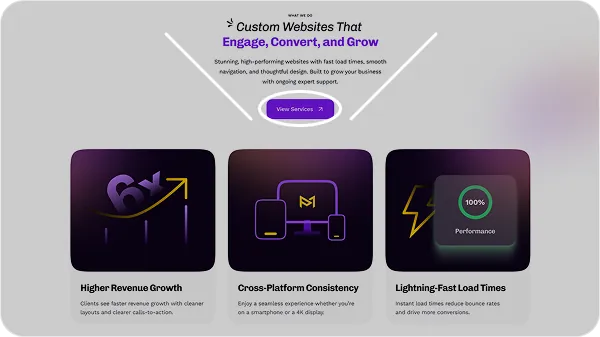
As shown above, the centered layout draws attention to the main call-to-action while introducing the business’s key deliverables in a clear visual order.
A page can include every recommended element, but it still needs original content to be useful. Unique location-specific information helps visitors and search engines understand why the page is relevant
Every location page should contain original content that reflects the area it serves. Instead of changing only the city name, include location-specific information, common customer needs, and local details that make each page genuinely useful and relevant.
Instead of repeating the same paragraphs, write about the specific location.
This creates useful content that search engines can understand and visitors appreciate.
The following are examples of location-specific information that adds value to a local landing page:
Avoid adding local information simply to fill space. Every sentence should provide value.
For example, a roofing company serving coastal Florida can discuss hurricane preparation, while the same company serving Colorado can explain snow load concerns. The service remains the same, but the local context changes naturally.
Writing unique pages takes longer, but it creates stronger long-term SEO value than publishing dozens of nearly identical pages.
After creating original content for every location, focus on the on-page SEO elements that help search engines interpret the page and improve its visibility for local searches.
On-page SEO helps search engines understand your local landing page while making it easier for visitors to navigate. Optimizing titles, headings, images, links, and other page elements improves relevance, usability, and search visibility.
Start with the page title. Include the primary service followed by the city.
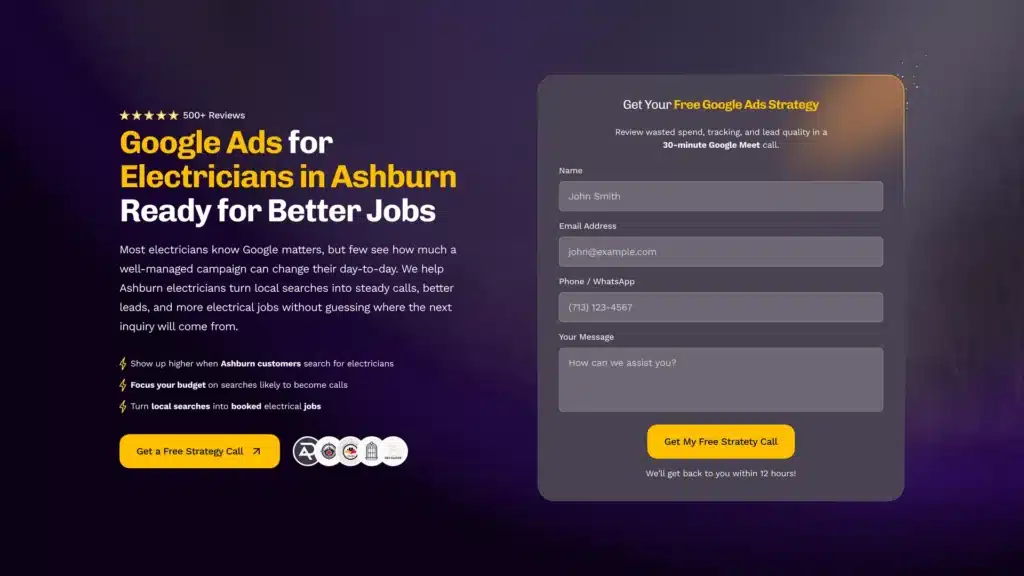
For example, the hero section above uses the title “Google Ads for Electricians in Ashburn” to clearly communicate both the primary service and the target location.
Next, write a compelling meta description that encourages people to click while accurately describing the page.
Headings should follow a logical structure. Use one H1, organize major sections with H2 headings, and introduce H3 headings only when covering detailed topics within a larger section.
Images also require optimization. Every image should include descriptive alt text rather than generic file names.
Internal links help visitors explore related pages while helping search engines understand the relationships between your content.
Review this checklist before publishing.
| SEO Element | Best Practice |
| Title Tag | Include service + city |
| Meta Description | Describe page naturally |
| URL | Short and descriptive |
| H1 | One primary heading |
| H2 | Organize major sections |
| Images | Descriptive alt text |
| Internal Links | Connect related pages |
| Schema | Add LocalBusiness markup |
| Mobile | Fully responsive |
| HTTPS | Secure connection |
Search engines also recommend avoiding keyword stuffing. Repeating the same phrase unnaturally reduces readability without improving rankings.
Google explains that content should primarily help people rather than search engines.
You can build strong on-page SEO by helping search engines better understand your content and business. The next step is providing structured business information that gives search engines additional context about your business and its location.
Use Local Business Schema by adding structured data that describes your business information in a format search engines can understand. Include accurate details such as your business name, address, phone number, website, opening hours, and service area.
Search engines understand webpages through both visible content and structured data. Local Business Schema helps explain important business details in a format search engines can process more accurately.
Schema does not directly improve rankings by itself. Instead, it helps search engines better understand your business information, reducing confusion about locations, services, and contact details.
Common Local Business Schema properties include:
The information inside the schema should exactly match the information displayed on the page.
If the address says “Suite 200” on the page but “Ste 200” in structured data, consistency begins to break down across different systems.
After adding schema, validate it using Google’s Rich Results Test.
Accurate structured data works best when it supports a website with clear navigation and well-connected pages. Schema explains your business information, while internal links explain how the rest of your website is connected. Together, they create a stronger foundation for local SEO.
Build a strong internal linking strategy by connecting each page to relevant content across your website. Link related services, locations, guides, and contact pages to help visitors navigate easily and search engines discover your content.
Without internal links, visitors often reach a dead end after reading one page. Search engines also have fewer paths for discovering related content.
The following types of internal links help visitors find related information and improve website navigation:
For example, a location page for “Plumber in Orlando” can naturally link to:
This helps visitors continue their journey without returning to the navigation menu.
Internal links also distribute authority across the website, making important pages easier for search engines to discover.
Avoid adding links simply because they exist. Every link should help readers continue learning or move closer to taking action.
A well-connected website feels organized instead of scattered.
Before publishing a page, confirm that it includes:
Completing this checklist improves both usability and long-term search visibility. Local landing pages perform best when they follow proven practices and avoid mistakes that reduce their effectiveness.
Common local SEO mistakes include duplicate content, keyword stuffing, targeting multiple locations on one page, missing SEO elements, and inaccurate business information. Avoiding these issues improves page quality, usability, and local search visibility.
Creating local landing pages takes time, but small mistakes can reduce their effectiveness. Many businesses focus only on adding city names while overlooking the factors that help pages rank and provide value to visitors.
One common mistake is publishing duplicate content across multiple locations. Replacing only the city name creates nearly identical pages that offer little unique information. Search engines expect each page to provide original content that answers local questions.
Another issue is targeting too many locations on one page. A page about roofing services in five different cities makes it harder for search engines to determine which location is most relevant. A dedicated page for each location creates stronger topical focus.
Many businesses also forget to include complete contact information. Missing addresses, inconsistent phone numbers, or outdated business hours create confusion for both visitors and search engines.
Avoid these common mistakes:
Avoiding these mistakes helps local landing pages perform more effectively over time. Measuring their performance helps you understand what is working and where improvements are needed.
Measure local SEO performance by tracking metrics such as impressions, clicks, rankings, engagement, and conversions. Reviewing this data regularly helps identify opportunities to improve visibility, user experience, and local search performance.
Publishing a landing page is only the beginning. Measuring performance helps identify what works and what needs improvement. Local SEO is a long-term strategy that benefits from regular review.
Google Search Console provides valuable insights into how your pages appear in search results. You can monitor impressions, clicks, average position, and search queries for each location page.
Google Business Profile Performance also shows how customers discover your business through local searches, Google Maps, and direct searches.
Google Analytics helps measure visitor behavior after they arrive. Pay attention to engagement rather than focusing only on traffic volume.
Important metrics to monitor include:
| Metric | Why It Matters |
| Impressions | Measures search visibility |
| Clicks | Indicates interest in your page |
| Click-Through Rate | Shows how attractive your listing is |
| Average Position | Tracks ranking improvements |
| Engaged Sessions | Measures visitor interaction |
| Contact Form Submissions | Indicates conversions |
| Phone Calls | Measures local inquiries |
| Direction Requests | Reflects local intent |
Avoid making large changes every week. SEO improvements often take time before search engines fully evaluate updated content.
Performance data highlights which pages need attention and which strategies are working well. Keeping location pages accurate and up to date helps maintain those results over time.
Keep location pages updated by regularly reviewing and improving their content, business information, images, and local details. Accurate, current pages remain more useful to visitors and help support long-term local SEO performance.
Search engines favor websites that remain accurate and well maintained. A location page should continue improving after publication instead of remaining unchanged for years.
Review every page several times each year. Update operating hours, contact details, services, pricing information where appropriate, and any local information that has changed.
Adding new content also signals that the page remains active.
Useful updates include:
As new customer questions appear, include them on the page. This keeps the content useful while expanding keyword coverage naturally.
Update neighborhood references, community events, transportation changes, or local developments that affect your services.
Replace older images with higher quality photographs that better represent the business location or services.
If visitors frequently ask about pricing, scheduling, warranties, or service areas, answer those questions directly on the page.
The U.S. Small Business Administration (SBA) encourages businesses to maintain accurate online information because customers depend on current details when making decisions.
Even well-maintained pages should also demonstrate credibility. Local signals help reinforce trust with both visitors and search engines by supporting the accuracy and relevance of your business information.
Build trust with local signals by displaying accurate business information, customer reviews, certifications, awards, and other verifiable details. These signals help visitors evaluate your credibility and support stronger local search performance.
A strong local landing page includes signals that reassure visitors they have found a credible business.

In the reviews section above, customer testimonials include each reviewer’s name, designation, and company, helping reinforce trust and credibility through identifiable customer experiences.
Helpful trust signals include:
Avoid adding trust badges that cannot be verified. Authentic information builds stronger credibility than decorative graphics.
The Federal Trade Commission (FTC) reminds businesses that advertising claims should be truthful and supported by evidence.
Security also contributes to trust. Visitors expect websites to load securely and protect their information. Secure hosting, HTTPS encryption, and regular website maintenance support both user confidence and search performance.
A trustworthy website answers questions clearly, provides accurate information, and makes contacting the business simple.
Create local SEO landing pages by focusing on one service and one location per page, writing unique and helpful content, optimizing technical SEO, maintaining accurate business information, and continuously improving each page based on user needs and search performance.
Local SEO succeeds by serving people first. Pages that answer real questions, provide valuable local information, and maintain strong technical foundations continue delivering value long after publication.
By combining thoughtful content, sound website architecture, and ongoing maintenance, businesses create landing pages that earn trust from both visitors and search engines.